Showing posts with label Philippines. Show all posts

Thursday, March 21, 2013

A Philippine Griswold? (Philippines)

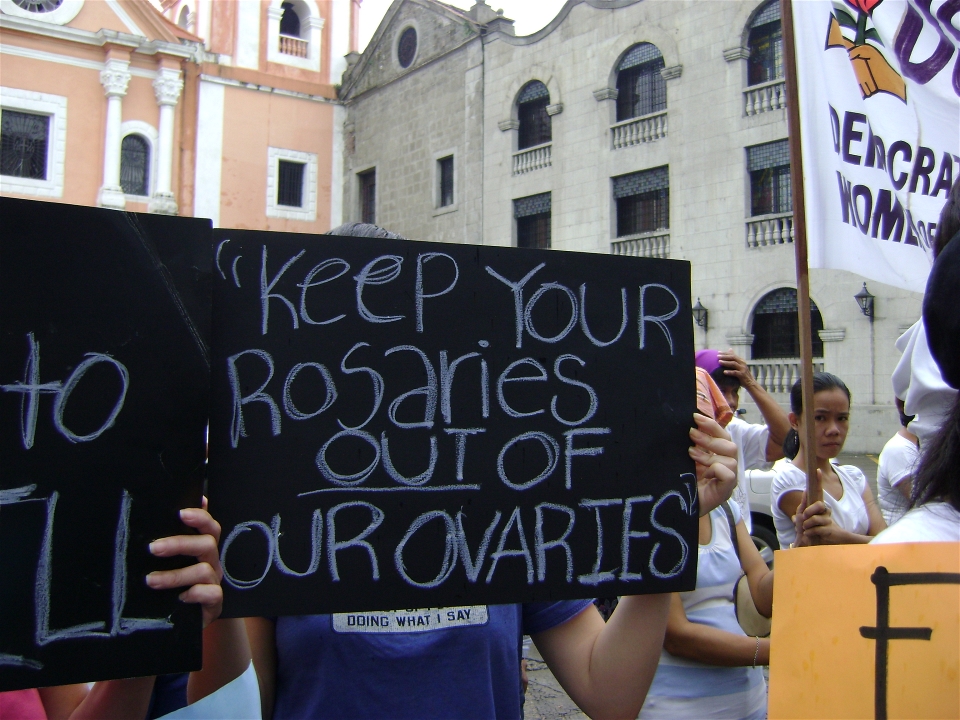
When comparing the Philippine Supreme Court's activism with that of the U.S., one of the biggest differences is that the Philippine court has not ventured deeply into the realm of reproductive rights. Now, the Aquino administration's new Reproductive Health law might have given the court's its own Griswold v. Connecticut. Among other things, the law would provide public funds to provide contraceptives (for more about the law and commentary, check out this IRIN article).

Catholic groups have challenged the law as potentially undermining the constitutional principle that the family is the fundamental social unit. The court has issued a temporary restraining order against the law until it hears oral arguments in June. Human rights groups have criticized the delay as risking women's health during the intervening four months.

Thus far, I haven't seen any attempts to "count" the likely votes of the justices. According to The Manila Times, 10 justices joined the TRO while 5 dissented. However, it's certainly not impossibly that three of the justices who signed the TRO would vote to uphold the law after oral arguments. The TRO is after all temporary and simply designed to allow the court to hear such a momentous case.

The case will also be a rest of Chief Justice Sereno's leadership. Sereno, an Aquino appointee, was one of the five justices to dissent. There is still little research about how the chief justiceship influences the votes of the other justices, but the Philippine Supreme Court chief justiceship is relatively strong and the justice has control over judicial budgets. Can she corral a majority on the court?

Friday, February 1, 2013

Book Review: What is the Philippine equivalent of Brown v. Board? (Philippines)

Marites Vitug is one of the more prominent critics of corruption and nepotism in the Philippine Supreme Court. However, in this book, she focuses on landmark rights cases from the Supreme Court. These are essentially the Philippine equivalents of Brown v. Board, Roe v. Wade, etc. Admittedly, not all of these cases result in victories for rights activists, but they are crucial to understanding Philippine jurisprudence. Vitug and Yabes provide a short overview of the case, but they really focus on the individuals and personalities involved. This is great for foreigners who can access the official judicial opinions easily enough on the Supreme Court's website but might not appreciate the context surrounding the case. It's particularly revealing to see some of the behind-the-scenes influence in some cases - the sort of personal touches that never make it into the written opinion. For example, in one of the mining cases, a former Supreme Court justice was a lawyer for one of the parties! In another case, Vitug and Yabes recount the scathing skepticism of the justices during oral argument. As with Vitug's Shadow of Doubt, this book is essentially reading for anybody interested in the modern Philippine judicial system.

Monday, October 29, 2012

Another Philippine TRO saga? (Philippines)

Just under a year ago, the Philippine Supreme Court issued a TRO preventing authorities from detaining former president Arroyo. Now, Arroyo stands accused of plunder along with 9 other defendants in a trial before the Sandiganbayan (anticorruption court). Arroyo and her co-defendants are accused of misusing funds from the Philippine Charity Sweepstakes Office.

According to reports yesterday, the Supreme Court issued a TRO enjoining the court from issuing an arrest warrant for Arroyo. Allegedly, a TRO for one of Arroyo's co-defendnats was to have covered her claims as well. 

Today, according to PhilStar, the Supreme Court backtracked and has said Arroyo's request for a TRO must be considered separately. Regardless, the Sandiganbayan had already continued the trial assuming the TRO did not cover Arroyo.

Of course, given the impeachment of former Chief Justice Renato last year, it's hard to believe that a TRO against the Arroyo corruption trial won't produce a backlash. However, the Aquino administration seems less confrontational - at least at this point. Presidential spokesman Edwin Lacierda even reacted to the bizarre news by stating, “Well, we respect, again, that is a decision coming from the Supreme Court and as always we respect the jurisdiction of the SC.”

Tuesday, July 31, 2012

Changing the rules midway through (Philippines)

The Philippine Supreme Court accepted a petition to strip Congress of one of its votes in the Judicial and Bar Council. Article VIII Section 8 (1) of the Constitution gives Congress "a" representative, not one for each chamber.

This comes ahead of an expected vote for a new chief justice following the impeachment of Renato Corona earlier this year. It is a bit surprising and possibly not a coincidence that the Supreme Court changed the voting rule after having two representatives since 2001. Perhaps the court thought that given Congress' vote to impeach Corona, they might disagree over judicial candidates.

Full article from PhilStar here.

Wednesday, June 27, 2012

The future of Philippine judicial reform?

In the aftermath of Chief Justice Corona's impeachment, Steven Rood and Carolyn Mercado have penned their thoughts on the prospects for judicial reform for the Asia Foundation's blog. It's a compact summary of prior reforms and will certainly make many hearken back to the Davide era.

Tuesday, May 29, 2012

He's out!

The Philippine Senate voted 20-3 to convict Corona. Turns out the vote wasn't even particularly close. Moreover, 2 out of the 3 senators who voted to acquit were either Marcos or Arroyo relatives. Here's an article summarizing the vote. I'll write more once the fallout is clear.

And if you were confused about the complex accusations against Corona, here is an article summarizing the legal case.

Wednesday, March 21, 2012

More Philippine Polls

More polls from the Philippines. According to Pulse Asia, 58% of respondents disapproved of Chief Justice Corona's job performance, while only 14% approved. Moreover, just 11% trust him. Moreover, both numbers dropped precipitously from November 2011, when the impeachment case against the chief justice began.

While Filipinos are notoriously cynical when it comes to politicians, it's worth comparing those numbers to President Aquino's, who received a 70% performance rating. Given these numbers, I just don't see politically how the chief justice can survive. Senators in the Philippines are elected on a national basis, so I'm sure they'll take note of these numbers when they vote on the impeachment case in the next few weeks.

I've included a convenient table below summarizing the survey results (click to enlarge):


Tuesday, March 20, 2012

Is the Philippines impeachment roadshow almost done?

We know the Senate is expected to vote on the impeachment of Chief Justice Corona fairly soon. Moreover, some lawmakers are now claiming that Corona's omission of assets in his Statement of Assets, Liabilities, and Net Worth constitutes a per se impeachable offense. The most definitive statements seem to be coming from the House, so they're not necessarily dispositive of the views of them majority of senators. Nonetheless, the trial thus far hasn't given Corona's defenders much to work with.

Perhaps more importantly it seems Filipinos themselves are finding their own conclusions about the trial. According to a recent survey, 58% will accept any Senate decision regarding the outcome of the case. Around half of respondents viewed the chief justice as guilty, while 43% remain uncertain. Based on Manila's distaste for Arroyo, I suspect Manila residents are more likely than not to consider Corona guilty, so if he is convicted we probably won't see any attempts to launch a People's Power movement against the administration. However, if Corona is acquitted, I wouldn't be surprised if Philippine politics gets a bit more contentious.

Monday, March 12, 2012

Thriller in Manila

The impeachment trial against Chief Justice Corona is almost reaching a conclusion. The Comparative Constitutions Blog has a great article summarizing recent developments in the trial. The authors seem a bit skeptical that the Senate will convict, but either way we should get an answer before Easter.

Thursday, March 8, 2012

Conflict of interest or interesting conflicts?

Of course, there's always been a large potential conflict of interest underlying the impeachment of Chief Justice Corona. Namely, President Aquino would have a chance to appoint another justice to the court if he succeeds. However, two recent articles raise other possible conflicts of interest. The Supreme Court of course decided the fate of the Aquino family's plantation in Hacienda Luisita. President Aquino adamantly denies any connection and points out that impeachment started with the Supreme Court's decisions on Arroyo and the TRO. Second, and perhaps more interesting, Chief Justice Corona has accused Justice Carpio's old firm (commonly known as "The Firm") as behind the "black propaganda" against him. Of course, should Corona be removed, Carpio would probably be his successor. The Firm denies any involvement in the impeachment, but the accusations do raise the question of whether Carpio can keep his hands entirely clean in this whole affair.

Thursday, February 23, 2012

How much bias is too much?

Prosecutors in the impeachment trial against Chief Justice Corona announced that the chief justice had favored Arroyo in 80% of the 31 cases involving the former president. While likely to be damning in the public eye, it's worth thinking about what those numbers actually mean. First of all, on average one would expect a the average unbiased judge to vote 50% in favor of any random plaintiff in a borderline case, so Corona voted 30% (80% - 50%) more often in favor of Arroyo than one might expect. The first question is whether that difference is meaningful, given that there were only 31 cases in the sample. The difference is large enough that it should be statistically significant, although one would also want to consider other factors that might account for the difference.

Wednesday, February 22, 2012

More impeachments

Looks like there's going to be a second impeachment trial coming soon to the Philippine Senate. The House voted 38-10 that there is probable cause to impeach Justice del Castillo, infamous for allegedly plagiarizing a Yale Law Review article. Some might argue this impeachment is based on stronger grounds than the politicized impeachment of Chief Justice Corona. However, it's also quite convenient for the Aquino administration to not one but two additional Supreme Court appointments if both impeachment cases reach conviction. Indeed, as it currently stands, only Roberto Abad's term will expire before the end of Aquino's presidential term, meaning that barring any deaths or unforeseen retirements Aquino would otherwise only have had opportunity to appoint one more justice.* By the looks of it, Aquino could leave the presidency with 6 of his justices on the bench, plus sympathetic justices like Carpio.

* Martin Villarama's term ends in April 2016, during the election season. This whole impeachment saga against Corona started when President Arroyo appointed Corona during the 2010 election season, which Aquino argued violated the ban on midnight appointments. Villarama's retirement should be an interested test of if Aquino accepts the midnight appointment ban when it constrains his presidency - or alternatively, if he suddenly decides that the Supreme Court made the right call in de Castro v. JBC.

Friday, February 17, 2012

The CJ Strikes Back

There's been no shortage of rude words between Chief Justice Corona and President Aquino. As the impeachment trial against Corona has progressed, the Senate has focused on his SALN and allegations of corruption. Now, the chief justice has responded by challenging the president to release his psychological records. According to PhilStar, Corona said that the President has an obligation to assure the public that their leader is "in his right mind." Harsh words! I can't imagine that the relationship will ever be repaired if Corona escapes impeachment.

Wednesday, February 15, 2012

Contemptuous contempt

The Supreme Court recently dismissed a complaint by several losing litigants against three Court of Appeals judges. Of course, losing parties often have an incentive to complain that decision was not fair. However, the Supreme Court then turned around and threatened the complainants with contempt "for degrading the judicial office of respondent Associate Justices of the Court of Appeals, and for interfering with the due performance of their work for the Judiciary." You can read more about the current case here.

One of the themes that emerged from Marites Vitug's Shadow of Doubt is that the Supreme Court protects its own. While the Supreme Court has every right to dismiss frivolous complaints against judges, is it taking things too far to threaten contempt? The real concern is that overusing contempt might discourage legitimate and useful public scrutiny of the courts. There is some research suggesting that public accountability, transparency, and media attention are key to improving judicial independence and quality.

This issue came up before when several law professors publicly complained that Justice del Castillo had plagiarized a U.S. law review article - a serious charge made by serious individuals. Then as now the Supreme Court accused them of contempt. Congress is in the process of deciding whether to impeach Justice del Castillo. However, it would probably be better for the courts if the public rather than the Congress acted as the judicial watchdog.

Saturday, January 21, 2012

Impeachment imbroglio

I haven't written much about the impeachment of Chief Justice Corona in the Philippines partly because events are moving so quickly that it's hard to post anything without it becoming obsolete the next day. Nonetheless, the main development now seems to be that prosecutors have found inconsistencies on Corona's Statement of Assets, Liabilities, and Net Worth (SALN) (for an overview of the charges, see here and here). This alone is an impeachable offense. Other allegations of corruption have arisen, including misappropriation of World Bank project funds (see the World Bank memo asking for the return of 8.6 million pesos here).

While I've been following the news pretty closely, I certainly don't recall any discussion of corruption as the basis for impeachment before the House voted last December. While these allegations of corruption certainly paint a disturbing picture of Corona's chief justiceship, I'm surprised that the trial has moved in this direction rather than focusing on the stated basis for impeachment, namely Corona's decisions. I hope the focus on real crimes means that the Philippines can minimize the damage the impeachment trial will have on judicial independence. If future judges see this impeachment as the legitimate removal of a corrupt official rathe than a politically motivated attack then all the better. However, while judges don't often state their positions publicly, what I've seen in news reports is that judges are sticking by their chief justice - at least for now.

Friday, January 6, 2012

Beyond the anti-Arroyo?

Aquino's legacy on the rule of law is still being determined. On the one hand, judges complain that the impeachment of Chief Justice Corona is becoming essentially trial by publicity. On the other hand, some human rights activists credit the president for going after former general Jovito Palparan, one of the masterminds behind extrajudicial killings against suspected leftists (although Palparan remains at large). Ironically, under the Puno Supreme Court had pushed for bringing human rights violators to justice while the Arroyo administration stalled. 

The central question for Aquino is whether he can get beyond the image as the "anti-Arroyo". Mark Dern in Asia Times highlights the problems plaguing the Philippine criminal justice sector. Perhaps justice-sector reform could be a way for Aquino to demonstrate his reform credentials and leave a legacy beyond simply rectifying the sins of the previous administration.

Tuesday, January 3, 2012

Updates from the Region

I'm still recovering from the Christmas break and trying to get catch up on the news. Here are a few important items:

Indonesia

According to The Jakarta Post, the Constitutional Court ruled that former political party members could not hold a seat in any election-organizing body, such as the General Elections Commission (KPU) or the General Elections Monitoring Body (Bawaslu), within 5 years of their retirement. The ruling was justified as preserving the impartiality and independence of those bodies.

Philippines

There's been more maneuvering in the impeachment of Chief Justice Corona. The Supreme Court is set to decide whether to issue a temporary restraining order against the Senate to prevent the impeachment from proceeding to a formal trial. Even more interesting, according to PhilStar, the case has been assigned to Justice Carpio, widely seen as Corona's most likely replacement. Stay tuned for what looks like high legal drama.

Monday, December 12, 2011

Crisis time!

While there has been much talk about a final showdown between the Aquino administration and the Corona Court, I was shocked to hear from BBC yesterday that the Congress actually impeached Chief Justice Corona. Just a few hours before I had read an article in which Corona talked of a secret conspiracy to oust him. Normally I'd have dismissed such talk, but at this point I've really got to wonder what the Aquino administration is thinking. The Philippines Supreme Court has been relatively independent since the EDSA. It has waded into a variety of politically charged questions, including term limits for President Ramos, the legality of EDSA II, and extrajudicial killings. The impeachment against Corona is the first time a Philippine justice has been impeached on blatantly political grounds. Even the impeachment against Davide nominally focused on the Court's alleged misappropriation of funds. Sadly, even if the Senate refuses to convict Corona the whole imbroglio might make Philippine justices think twice about taking on political cases.

Wednesday, December 7, 2011

More fighting words

On Monday, President Aquino attended a justice cooperation summit with many of the serving Supreme Court justices. Usually, these are rather formal and stiff affairs. However, Aquino gave a speech lambasting Chief Justice Corona for ruling against the administration and being beholden to Arroyo.

Of course Aquino had criticized the justice before, but this particular speech was shocking for its directness and confrontation with the justices in the same room. Several constitutional law experts have attacked Aquino for his "tirade," one going so far as to compare him to Fidel Castro.

For his part, Corona confirmed that he is not resigning. He has rarely participated in the "debate" directly, but rather spoken through Supreme Court Spokesman Midas Marquez. On Tuesday, Marquez stated that, “It is just unfortunate that the Chief Justice was appointed by someone that many do not like. Now they are attacking him. It’s not his fault."

It'll be interesting to see what polls say about Aquino's attacks on the judiciary. I haven't been in the country in a while so I unfortunately don't have a sense on the ground.

Monday, December 5, 2011

Updates on the Arroyo imbroglio

Apologies for not writing more about the current imbroglio with former Philippine president Arroyo and the Supreme Court. This is easily one of the biggest tests of the court's independence over the past decade. News coverage has been wall-to-wall in the Philippines of course. Here are some excepts from an Asia Times piece - I'll write more when I can:
The DoJ justified its move on the legal argument it had not yet received the Supreme Court's temporary restraining order when Arroyo arrived at the airport. The Supreme Court has since suggested it could file contempt charges against DoJ Secretary Leila de Lima, while pro-Arroyo attorneys are seeking de Lima's disbarment for apparently flouting the Supreme Court's decision.
...
In the court of public opinion, however, sentiment seems to be on Aquino's side. Opinion polls show that both Arroyo and the Supreme Court are unpopular and suffer from credibility issues in the public eye. "It is no less corrupt than the rest of the Philippine judicial system," quipped Pacific Strategies and Assessments, a risk analysis firm, in recent reference to the Supreme Court's apparent role in protecting Arroyo from prosecution.

While the Supreme Court insists its decisions are consistent with the letter of the law, its record when ruling on cases involving the Arroyos has been overwhelmingly in the former first couple's favor. Chief Justice Corona has voted 19 times in favor of the Arroyos and never in dissent since taking over the Supreme Court's leadership. Two senators and a number of prominent individuals have recently asked Corona to inhibit himself from any future deliberations involving Arroyo to concerns of his impartiality.

The Supreme Court is currently holding oral arguments on petitions filed on the constitutionality of the DOJ-Commission on Elections (Comelec) joint panel, which recommended Arroyo's prosecution for alleged electoral fraud in 2007. Based on that recommendation, an arrest warrant was issued by the Pasay Regional Trial Court (RTC) judge against Arroyo, which puts to rest for now the question of whether she should be allowed to travel abroad.